Abdominal Bracing – Stability
Learning to use your abs, your pelvic floor, and your back muscles together.
This is more than a exercise. It is a basic principle for getting your back working well again. The idea is to use your back, belly and pelvic floor muscles together to help stabilize your spine in a neutral position. Use this stable position throughout your day.
1. Find your neutral spine position – Start sitting, gently pelvic tilt, alternating a few times between rounding your low back, and arching your low back. Use your stomach and buttock muscles to do this, not your whole body. Relax for a couple seconds and find neutral, a comfortable place in between, with a slightly concave lower back. Maintain neutral in your low back as you do the exercise.
2. Pull In – Brace by pulling your belly button toward your spine. Keep your spine in neutral, with a slight curve as you do this. A good way to get there is to imagine that you are pulling on tight jeans.
3. Lift the Pelvic Floor (Keigels) – Tighten the lowest muscles of your pelvis, as if you are trying to stop urinating (imagine “zipping up”). If your gluts fire, you are trying too hard.
4. Activate your deep back muscles – Lift your tail and/or lift your rib cage. You will feel like you are trying to slightly arch your back, but your abdominal bracing will keep it from arching too much.
Initiate each of these actions, one at a time, with an out breath. On your in breath, breathe into the lower rib cage. Use 30%-40% of maximum effort, and hold for 10-30 seconds. You are developing endurance, not brute strength. Practice this series of actions sitting, standing, and lying on your belly and back. Use this stable trunk position, step-by-step, whenever you bend, twist or lift.
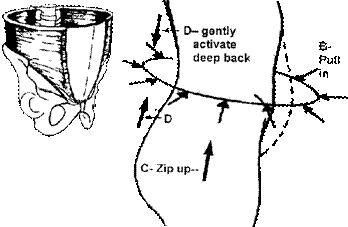
On the right are pictured the abdominal muscles we want to strengthen. Note that they go all the way around from the front to the back.
The second picture shows what the trunk muscles do.
The transverse abs (B) pull both the belly and the back inward. The deep pelvic floor muscles (C) pull the muscular floor of the pelvis upward. The deep back muscles (D) keep the back in neutral by slightly arching it. These muscles balance each other, creating a strong stable spinal column. |
|
|